
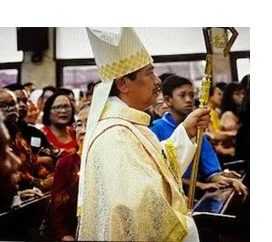
Some aspects of the person and ministry of the bishop
The following letter has been sent today to Msgr. Felix Glenn and members of Study Group 7 in response to their interim report. We offer our thanks to the Wijngaards Institute who invested extensive time to research the history of how bishops were selected in the early church. Working with them over the past couple of years, CCRI has put considerable time into holding online Conversations in the Spirit and presentations on this issue of having the people involved in the selection process of their own bishop. We feel that changing the selection process of bishops in each diocese to a synodal one involving the people of the community will have a transforming and extremely positive impact on the functioning of dioceses around the world. But for this to happen, it will take time. We encourage this study group to request an expansion of their deadline allowing enough time for them to complete their work and truly make an impact on actualizing this process in local communities.
December 21, 2025
Dear Msgr. Felix Genn and members of Study Group 7 as you evaluate some aspects of the person and ministry of the bishop:
We are pleased to see you reach out to many people – 200 in all – seeking their input for your work. This is such an important issue in the future synodal development of our Church. In paragraph 148 of the Final Document for the 2024 Synod on Synodality, it says: “Throughout the synodal process, a widely expressed request was that discernment and formation of candidates for ordained ministry be undertaken in a synodal way. There should be a significant presence of women, an immersion in the daily life of communities, and formation to enable collaboration with everyone in the Church….” We are fully supportive of your reaching the conclusion of the importance “to draw inspiration from the Church’s Tradition concerning the ecclesial nature of the selection process of Bishops” as we see little or no elements of synodality in the current method of this selection process. And we appreciate your reinforcing both “the role of the local Church as the natural setting for discernment both regarding its new Shepherd and regarding diocesan Presbyters to be proposed as possible candidates to the episcopacy,” and your desire “to foster greater investment in the formation of the People of God, helping the faithful of each local Church (ordained ministers, consecrated persons, and lay women and men) to develop the spiritual sensitivity and discernment skills necessary for this purpose.”
In your report, we recommend that you:
- Expand the concept of “spiritual sensitivity and discernment skills” by providing the People of God with accessible formation materials that explain the qualities, charisms, and competencies needed in episcopal leadership for a missionary synodal Church, thus enabling more informed and substantive participation in the consultation process.
- Create transparent feedback loops wherein local Churches and the congregation that participate in the selection process receive appropriate communication about how their input was received and considered, fostering trust and demonstrating that their participation in the process is genuine and valued, not merely consultative.
As you develop each of these areas, we offer our research and Spirit-guided reflections with you on
· criteria for selecting candidates to the episcopacy.
· the judicial function of bishops.
· the nature and structure of ad limina Apostolorum visits.
Criteria for selecting candidates to the episcopacy:
Having the people involved in the selection of their own bishop is not a doctrine that requires changing but rather a practice that requires changing. The democratic election of bishops has impeccable biblical and historical credentials such as Mathhew 18:15-18 where Jesus teaches step by step how to resolve conflict within the community. This passage has Jesus explicitly mandating the entire community as the highest and final authority for adjudicating disputes about “sin” (and so on moral and doctrinal issues too).
History shows that church leaders, and bishops specifically, have long been democratically elected by the local church. Two of the most well-known examples of this are the election by acclamation of Ambrose as bishop of Milan, when he was not even baptized yet, and the election of Augustine as bishop of Hippo. Democratic elections of bishops were often regarded as necessary for the legitimacy of the appointment, and a sign of God’s will. In 428, Pope Celestine created a phrase which was to resonate for centuries throughout Latin Christianity: “No bishop is to be given to those who do not want him: the agreement and wish of the clergy, people and local council (ordo) are necessary’.” Less than twenty years later, in 445, Pope Leo the Great went on to coin a principle which goes even further than Celestine’s: “Who is to preside overall, must be elected by all.” All of this makes us wonder why we ever abandoned the original practice of democratic elections of church leaders by the community.
There are two main objections to the reintroduction of episcopal elections. The first is that they would reintroduce factionalism and lobbying. The second is that most people would not generally know any priest apart from their parish priest. The very real danger is that the candidates most likely to win are likely to be the parish priests of big parishes, whose “electoral base” is significantly larger than that of pastors of smaller congregations. The answer to both objections lies in ensuring that an electoral procedure has the necessary resources for maximizing the dissemination of information concerning candidates’ background. The more secretive the system, the greater the probability that factionalism, politicking and lobbying by competing cliques of insiders mar the selection process. A public and transparent electoral process minimizes the dangers of those actions much more than the current system. Leverage all ecclesial resources to facilitate the crucial stage of information exchange and open debate needed for the electorate to be able to make an informed decision. Ideally, you’d want to cast your nets wide and allow all people with a wealth of expertise to put themselves forward for the vacancy.
Here is a step-by-step concrete proposal for reintroducing episcopal elections advanced in 1848 by priest, philosopher and theologian Antonio Rosmini, who is now officially Blessed, and serves as the current constitution of the Orthodox Church of Cyprus.
Suggestions from recent synodal gatherings of the qualities desired in a bishop:
One who
· is a servant leader who listens and is inclusive
· with a track record of social justice encouraging others
· holds pastoral care as primary, going out to the marginalized
· puts into practice that which has been advised in the synodal report
· is a multi-issue person, as opposed to a single-issue person
· tells the truth with no history of sexual abuse coverups
· is readily accessible to all
· is a people person, engaging yet with substance
· emphasizes feminine characteristics, a model of caring for all, utilizing he/she pronouns
· embracing and celebrating all cultures
Suggestions from synodal gatherings of preliminary decisions regarding process for the election of a bishop:
· Nomination process for selecting candidates should come from clergy, nuns, knowledgeable laity, and diocesan staff who best know the potential nominees for bishop to offer a list of names of possible candidates as nominees for the position of bishop.
· This list should go to the diocesan pastoral council for further Conversations in the Spirit and discernment discussion, who may offer a short lister of candidates.
· A period of public discernment should be long enough to allow time for the faith community to hear from and be able to interview the various candidates.
· Utilize Conversations in the Spirit throughout the diocese prior to the election.
· Method agreed up for how votes will be cast to involve everyone in the diocese.
· Ordination of the bishop should be a major celebration in the diocese with all invited including other faith communities, to be ecumenical.
Having the people involved in the selection of their bishop is also one of the best ways to advance synodality. Without reintroducing episcopal elections, synodality will continue to be a half-baked idea with very little meaningful implementation.
Jesus’ number one job requirement for one to be a leader in his community is to be a servant to all. “You know among the pagans the rulers lord it over them, and their great men make their authority felt. This is not to happen among you. No; anyone who wants to be great among you must be your servant, and anyone who wants to be first among you must be your slave, just as the Son of Man came not to be served but to serve, and to give his life as a ransom for many.” (Mt 20:24-28)
Another key requirement is that the bishop is a “bridge-builder” who can unite the different factions in the community, so they are kind and respectful of one another and are able to work together for the common good.
The bishop needs to be open, welcoming a wide range of initiatives reflecting the talents and competencies of his flock.
The bishop needs to give more weight to “ortho-proxy” i.e., Jesus-like behavior than to “ortho-doxy”, i.e., correct doctrine.
Disqualifiers are those who are meddlesome micro-managers, those who have a clericalist (superior) mind-set and/or are autocratic, “culture warriors,” one who is only able to hold one pre-eminent issue, e.g., such as far too many US bishops who maintained that abortion was the pre-eminent issue in the presidential election.
The process for the election of a bishop should be seen in the context of the Universal Catholic Church. Each continent, each country, each Local Church has its unique features. The process in a rural, agricultural diocese in the Global South is going to be different than the process in an urban, internet-savvy diocese in the West. Common denominators are a holy bishop, a pastoral bishop, a synodal, listening bishop and a good administrator.
The judicial function of Bishops
· Establish an effective, unified synodal team at the outset of his ministry
· Set up numerous Conversations in the Spirit throughout the parishes to discern the needs of each parish community with the bishop and the synodal team personally participating in as many as possible
· Be readily available to all members of the diocese
· Make visits to each parish
· Perform the expected duties of the bishop, such as presiding at Confirmation
The nature and structure of ad limina Apostolorum visits
Include lay and clerical members of the diocese in these visits.
We close by congratulating you on your work and eagerly look forward to your final report. We encourage you to expand the deadline for this report to allow yourself enough time to finalize a report that is not just laid out in theory but encourages the process to be actualized in local dioceses globally.
Yours in Christ,
The CCRI team