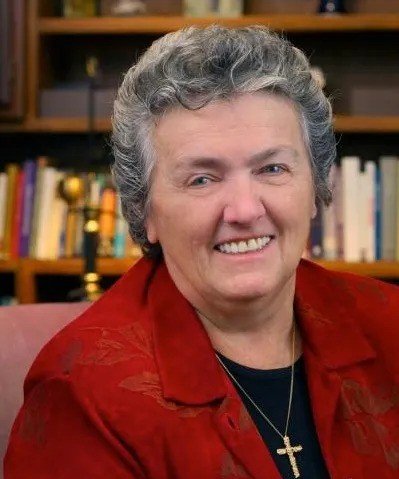
While in Rome, we met Bernadette Rudolph, MA, MS. She has offered to host an online workshop for us.
As someone who has worked for ten years in a parish and then five years in the Office for Parish Life in the Diocese of Scranton, Pennsylvania, Bernadette understands how synodality can inspire and support co-responsibility in parish life. If your parish or community struggles to engage all its members and to build relationships with others, imagine it being rejuvenated by respectful dialogue and genuine encounters.
If you are already part of a vibrant parish or community, consider what would happen if more people were invited to create and carry out a mission and vision they discerned together.
If you want to bring synodality to your parish, we will schedule a time to offer this. If there is sufficient interest, we may offer this more than once.
If this interests you, please sign up here, and we’ll keep you informed.
Are you aware that Pope Francis has set the entire Church on a four-year journey to become a more synodal Church? What does that mean and why should you care?
In a synodal Church, we become a people characterized by participation, communion and mission. Everyone has a voice because we acknowledge that the Holy Spirit lives in each person. Everyone has gifts to offer the whole. We walk together as disciples on The Way of Jesus – not on separate journeys or even similar journeys, but one journey as God’s people.
Being synodal matters when we have decisions to make. It matters as we figure out how the Church should approach the world and handle our problems. It matters as we imagine our future. God is with us and has a plan. A synodal Church can receive it and bring it to life – together. Jesus consistently rooted his ministry in prayer and encounter; synodality calls us to do the same. This journey is lifelong.
How can you and your parish join in?
If you are part of a leadership or ministry team in a parish or would like to be, you and your team could grow through this workshop into a team equipped to bring synodality to life for the people you serve and to participate in the dreams God has for you and the Church.
At the end of this workshop, your team will be able to:
- Practice spiritual discernment – of God as real in your life, of the Holy Spirit working in and through you; of the Holy Spirit working in and through others.
- Understand and practice elements of synodality: storytelling, deep and active listening, dialogue, spiritual and communal discernment, and co-responsibility.
- Identify possible places where you could bring what you’ve learned back to your parish community.
What people are saying about “How to Become a Synodal Parish”
- This was a positive experience that gave me the language to communicate more effectively about why this synodal process is so important and transformative for the church.
- Calling on the Spirit in our conversation reduces our anxiety and allows us to listen.
- The program was fully on point, with just the right pace and balance of input and engagement.
- Moving from scoffing into an attitude of positive doing.
- We had great connections and we could take the courses at home. Very good use of remote learning.
- We were given good tools. We will have to put them into practice and come back for more help. • This should be widely promoted at ALL the parishes!
Synodal Approach for The Selection of Bishops

In the spirit of synodalidy, on Saturday, November 23, the int’l networks are sponsoring an online event guiding local parish communities into suggested ways for involving the whole community in the selection of bishops and pastors. A good time to introduce this practice is upon their retirement.
Margaret Mary Moore, Luca Badini, and Patrick Carolan led a presentation on this topic in September: https://catholicchurchreformintl.org/report-on-the-selection-of-church-leadership/.
Fr. Tom Reese, who writes for Religion News Service and has been promoting this concept for decades, will participate in this discussion as this has been one of his personal hopes for the church. This practice follows the example of the early Church, which involved the entire community in matters that impacted all the people making up the community.
Reading the New Testament, it is not difficult to notice that the earliest disciples of Jesus took the advice of their teacher seriously. And so we see that all the crucial early ecclesial decisions – whether to do with discipline, doctrine, or the selection of leaders – are taken democratically.
History shows that church leaders, and bishops specifically, have long been democratically elected by the local church: two of the most well-known examples of this are the election by acclamation of Ambrose as bishop of Milan, when he was not even baptized yet, and the election of Augustine as bishop of Hippo. Democratic elections of bishops were often regarded as necessary for the legitimacy of the appointment, and a sign of God’s will. Around 380, Ambrose of Milan echoed Cyprian some decades before, “rightly it is believed that he whom all have asked for [as bishop] is chosen by the judgment of God.” In 428, Pope Celestine created a phrase which was to resonate for centuries throughout Latin Christianity: “No bishop is to be given to those who do not want him: the agreement and wish of the clergy, people and local council (ordo) are necessary.” Less than twenty years later, in 445, Pope Leo the Great went on to coin a principle which goes even further than Celestine’s: “who is to preside over all, must be elected by all.”
The current highly centralized and non-transparent method of appointing bishops, whereby the Roman Curia and ultimately the Pope appoint almost every bishop in the world, is a relatively recent development of the last century or so, and the same applies to the enormous restriction of the pool of eligible candidates to ordained priests only. The question, then, is not “Can we do it?”, or “Does the bible or church history allow us to do it?” The question we should be asking instead is “Why have we abandoned the original practice of democratic elections of church leaders by the community?
[from Luca Badini’s presentation made on Sept. 11, 2024]
Your donations are most appreciated
YOUR GIFT – IN ANY AMOUNT – IS PRICELESS
When you make a donation to support our cause, you join with others who are investing in restoring our Church to what Jesus intended. The dollars we receive are used to run our programs and to reach a broad spectrum of the People of God. We are focused on reaching out to the Faithful, reform activists, young adults as well as those who feel abandoned by the Church, to mention just a few. Your personal contributions in offering your suggestions and your donations are most appreciated.
We have begun to genuinely join our voices together behaving as a synodal Church. Let us now stay abreast of what is happening with each stage of the Synod from now through 2024 and beyond. The real work of becoming a synodal Church is still ahead of us. It is crucial that we stay involved in the process. We will keep you informed and continue to gather online as a community.
On behalf of the CCRI steering committee,
Rene Reid, CCRI director