
This article is brought to you by
Eureka Street, an Australian Jesuit magazine
Recently, the Vatican ruled out – for now – women entering the diaconate. In doing so, it drew on a theological argument long used to justify the Church’s restriction of priestly ordination to men: that the ordained minister acts in the ‘person of Christ’, and that this representation requires sacramental similarity to Jesus Christ, who was male.
While the question of women priests has been considered closed by the Church, the extension of this argument to women deacons warrants closer examination. In particular, it raises questions about what it truly means to act ‘in the person of Christ’, and whether the application of this concept to the diaconate is theologically consistent.
When we consider the wide diversity of those admitted to Holy Orders across race, ethnicity, age, height and build, facial features, hair and skin colour, we can comfortably conclude that resembling or representing the ‘person of Christ’ has never been understood as a matter of physical appearance or ethnicity.
Similarly, recent Vatican guidance during the pontificate of Pope Francis has clarified that homosexual orientation in itself does not preclude men from priestly formation, provided candidates live in accordance with the Church’s expectations regarding chastity. This indicates that sexual orientation is not regarded as determinative of one’s capacity to act in the person of Christ.
Marital status also appears irrelevant to this representation. Deacons are frequently married, while Jesus was not. Priests vow celibacy; deacons ordinarily do not. Clearly, marital state is not considered essential to acting in the person of Christ.
Nor do stereotypically “masculine” traits or interests function as criteria.
Priestly vocations have emerged from professions such as nursing, social work, and early childhood education, fields often culturally associated with women. Indeed, many of the qualities prized in ordained ministry — listening, empathy, communication, community-building, compassion — are often described, however imprecisely, as “feminine.” Yet these qualities are welcomed rather than regarded as obstacles to sacramental representation.
Taken together, these considerations suggest that acting in the person of Christ is not grounded in physical resemblance, ethnicity, marital status, sexual orientation, or masculine traits.
Accordingly, and adopting modern distinctions made between the terms ‘sex’ and ‘gender’, it seems the remaining criterion for acting in the person of Christ appears to be biological sex alone. That is, in practice, eligibility for Holy Orders — including the diaconate — rests on the possession of a male body.
This narrowing raises an uncomfortable question. Can the fullness of who Christ is, the source of mercy and justice, wisdom and self-giving love, saviour and servant, be reduced to biological sex alone? Such a reduction risks flattening the richness of Christ’s humanity and mission into a single physical attribute, rather than a total life offered for the salvation of the world.
Some would argue that acting in the person of Christ refers less to Jesus as an individual historical male and more to Christ as the anointed saviour who offers himself for humanity. Within this framework, Jesus’ maleness is not the defining feature of his self-sacrifice. Others maintain that because Jesus chose to enter history as a man, this choice must be continued sacramentally through exclusively male ordination. Yet Jesus also entered history as a Jew, within a particular lineage and culture, and nevertheless extended his mission beyond those boundaries to Gentiles and outsiders. His ministry repeatedly begins from a select group and extends to all.
Yet the Church’s current conclusions regarding women deacons appear partial, shaped by selective emphases in scriptural interpretation often favouring women’s exclusion.
For example, when considering women deacons, focus is placed on the sex of Jesus, while other scriptural dimensions are downplayed. The Gospels present Christ as embodying both the Word (Logos) and the Wisdom (Sophia) of God, imagery traditionally gendered as male and female. Yet this richness is rarely integrated into contemporary arguments.
A similar pattern appears in relation to physical disability. Scriptural passages once excluded those with bodily ‘blemishes’ from serving at the altar (cf. Leviticus 21). Today, such texts are interpreted symbolically, allowing men with disabilities to be ordained on the basis of spiritual rather than physical perfection, leaving open the path to Holy Orders for men with disabilities.
This shift in interpretation rightly reflects deeper theological understanding. Yet no comparable generosity is extended to women, whose exclusion is justified through a literal reading focused narrowly on sex. Here, men benefit from symbolic interpretation; women are restricted by the literal.
Other arguments against women deacons rely less on Scripture than on ecclesial or cultural tradition.
While terms such as “ordination” and “Holy Orders” do not appear explicitly in the New Testament, they are treated as decisive in limiting women’s participation in the Church’s hierarchy. By contrast, explicit scriptural references to Phoebe as a deacon of the Church are routinely minimised, despite St Paul’s choice to entrust Phoebe, not one of the named male deacons, with carrying his letter to the Romans, a task central to the proclamation of the Gospel.
Likewise, Jesus chose Mary Magdalene, rather than a male apostle, as the first witness and herald of his resurrection. Proclaiming the Good News is a defining dimension of diaconal ministry, yet these precedents are often sidelined.
While semantics over the precise meaning of diakonos continues, broader considerations like pastoral need, vocational discernment, ability, and common sense, are frequently marginalised. In their place, ecclesial stability and fear of division can take precedence. Those in the Church averse to change and those who err towards a paradigm of exclusivity are indulged, while the voices of faithful women simply seeking to follow an authentic calling are deferred or discounted.
As women ourselves, we may unintentionally contribute to this impasse. Habituated to prioritising harmony, many of us avoid asserting our convictions for fear of conflict. Women are taken advantage of when we prioritise peace-keeping and tolerance over self-assertion. We choose to avoid seeing any prejudice against us so as to not rock the boat. We do not resist when we are encouraged to show endless patience, gagged with platitudes of ‘our time will come,’ and restricted through a choice-selection of Biblical verses. Our feelings of anger and disappointment are questioned or reframed as the consequence of ambition, rather than recognised as the consequence of an unfulfilled vocation.
Yet we need to acknowledge that there are numerous women expressing a clear calling towards the diaconate, including many good and faithful Catholic women within Catholic employment and religious orders. Are these callings not worthy of formal discernment?
Even if the Church ultimately judges that women cannot be ordained as deacons, at some point there needs to be an official response to these women even if out of respect alone. Women whose faith and capacity deemed them trustworthy enough to be included within formal Catholic institutions, and whose vocational discernment to religious orders was considered valid, but whose discernment in this matter is somehow deemed categorically invalid and not of God.
In fact, the most recent Vatican study, The Commission for the Study of the Diaconate of Women, established under Pope Francis and whose findings informed the 2024–25 discernment process, acknowledged complex long-term impact of historical issues in this area, but stopped short of recommending change. Its conclusions, reflected indirectly in documents from the Dicastery for the Doctrine of the Faith and in Pope Francis’ own remarks, often framed women’s discernment in terms of desires for recognition or authority, with discernment of vocation dismissed as feelings, rather than as potential movements of the Holy Spirit.
Conclusions on the validity of a female diaconate drawn through these formal ‘research groups’, formed at the request of one pope and curbed at the request of another, while shaped by historical constraints, internal tensions, and shifting ecclesial priorities, might not be the most spiritually authentic or revealing.
In line with true synodality, grass-roots-level discernment also needs to be considered. Convinced of the Holy Spirit’s consistent teaching in such matters, one constructive path forward would be to assess women expressing a diaconal vocation through the same processes used for male candidates.
If discernment consistently confirms that such vocations are not of God, it would offer clarity and closure for these women nurturing a particular vocation. If, however, the Spirit reveals something broader than current assumptions allow, the Church would be invited into deeper fidelity.
Those women who clearly sense a calling to the diaconate may one day face spiritual accountability for not fighting harder for their vocations. Equally, those who have proven to be a hindrance to these women following their vocation through inadequate or prejudicial discernment processes may bear responsibility for obscuring the Spirit’s work. The Church has long affirmed its authority to ‘bind and loose’ in light of growing understanding (Matthew 16:19). This authority exists precisely so that the Gospel may be proclaimed more fully within changing contexts.
The Church often speaks of the ‘feminine genius’ as a gift. That gift already stands at the Church’s doorstep, in service of the Church’s objective to spread the Gospel, with the ultimate aim of drawing people to God’s love.
A deacon’s life is one of service, liturgy, and proclamation of the Word. There is no gender to loving God. No gender to sacrifice. No gender to justice, mercy, compassion, or service. These are the qualities Christ embodied and entrusted to his Church. Rather than excluding women solely on the basis of sex, the Church might better serve its mission by embracing all who seek to embody Christ’s self-giving love, and to draw others into the wide mercy of God.
Dr Nimmi Candappa is a Melbourne writer, Plenary Council member and academic. She was a prominent member of and contributor to the Australian Plenary Council.
Please share this with your networks and anyone you think may be interested.
Our letter Intended for Study Group 5
established by Pope Francis
Sadly, we were notified on March 3 from the Synod office that our letter signed by several global reform communities never reached Cardinal Fernandez and the members of Study Group Five. The reason given is shown here:
From: Synodus <synodus@synod.va> W
Sent: Tuesday, March 3, 2026 8:07 AM
Subject: R: Would appreciate knowing if our letters reached to Committees
Dear Ms. Reid,
First of all, please accept our apologies for the delay in replying.
We wish to inform you that the contributions intended for the study groups were received after the deadline, as many of the groups have already concluded their work.
In any case, we would like to assure you that we have forwarded your contributions to the competent study group. Where still possible, they will be taken into consideration (certainly in the case of the Group on the Liturgy, which is still at work).
Yours sincerely,
The Secretariat
As shown below, our letter was sent on December 16, 2025. Had it been read, it would have been unmistakably clear that we were urging Study Group 5 to request an extension of their deadline—not to adopt or defer to Cardinal Petrocchi’s unilateral decision denying women the right to the diaconate. Since final reports were not due until December 31, 2025 nor was it actually released until March 10, 2026, there was ample time for Cardinal Fernández to receive our letter and act on it.
Our request was simple and entirely consistent with the mandate given to Study Group 5 by Pope Francis. Specifically, we were asking the committee to extend their deadline and:
- Acknowledge publicly in their final report the full sequence of events and the factual record, ensuring that neither the Synod nor the Faithful are kept from the truth.
- Reassert the original mandate and proceed with a full, impartial examination of the theological and canonical questions entrusted to them.
- Guarantee that the procedures used to address this issue are transparent, rigorously evaluated, and accountable to both the Synod and the Church.
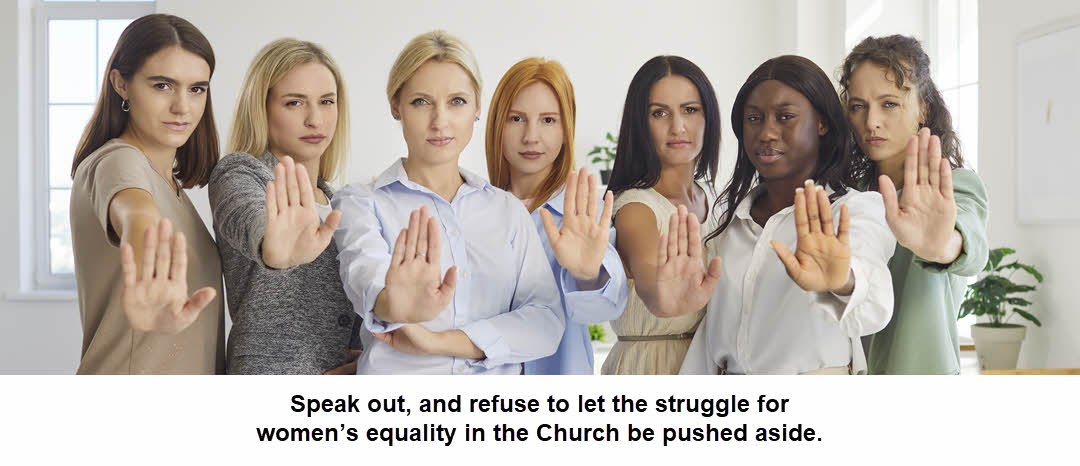
The fact that our letter was withheld from the committee is unacceptable. We can no longer remain silent while such wrongful maneuverings distort the process and suppress the truth. We call on every concerned reform movement to stand up, speak out, and refuse to let the struggle for women’s equality in the Church be pushed aside.
Open Letter to Cardinal Fernandez and Study Group 5
On Theological and Canonical Matters Regarding Ministerial Roles
December 16, 2025
There are serious concerns about the procedure for evaluating how Women’s Ordination to the Diaconate has been handled by Church leadership. This matter has neither been handled synodally nor transparently.
Study Group 5 was formally tasked in February 2024 to examine theological and canonical questions about ministerial roles, explicitly including whether women may serve as ordained deacons. It has since emerged that the earlier Commission on the Female Diaconate, called by Pope Francis in 2020 and chaired by Cardinal Petrocchi, acted independently and without transparency. Neither the Faithful nor the delegates for the 2023 and 2024 Synods were informed that the Commission had effectively concluded its work at its second session in July 2022—voting overwhelmingly to exclude women from the sacramental diaconate and then suspending further meetings.
Lack of Transparency and Its Consequences
Despite that conclusion, the Commission continued to present itself as active, creating the false impression that the question remained under open and impartial consideration. In his presentation to Synod delegates in October 2024, as the overseer for Study Group 5, you Cardinal Fernández, acknowledged that the Commission had been composed solely of members of the Dicastery for the Doctrine of the Faith, and your responses to Synod delegates revealed a predisposition against the inclusion of women while urging exploration of other forms of leadership. America Magazine has fully documented this sequence of events and the resulting confusion.
This pattern—decisions taken in a narrow forum, followed by the appearance of ongoing deliberation—has misled the Synod, the delegates, and the wider Church. To suggest that Christ’s maleness alone settles the question of women’s ordination is a theological claim that many find insubstantial and unpersuasive. This claim needs to be unilaterally dismissed so that the issue of women’s diaconate can be given more engagement and scrutiny. Further, we would like to see all the material submitted to the first Commission established back in 2016.
Appeal for Integrity and Proper Jurisdiction
The present maneuvering now is at risk of allowing Study Group 5 to avoid their responsibility by removing this mandate from your jurisdiction. You were given a mandate to study the female diaconate apart from the Commission set up in 2020. The Faithful and Synod delegates have already been misled by the earlier process of the Petrocchi Commission on the Female Diaconate. It would be a grave mistake to allow that deception to continue unchallenged.
We therefore respectfully but firmly request that you, Cardinal Fernández, and all members of Study Group 5:
- Acknowledge publicly in your final report the sequence of events and the factual record so that the Synod and the Faithful are not shut out from the truth.
- Reassert the original mandate given to you and proceed with full, impartial examination of the theological and canonical questions assigned to you.
- Ensure that the procedures used to address this question are transparent, thoroughly examined, and accountable to the Synod and the Church.
A Final, Pastoral Appeal
This attempt to avoid dealing with the Women’s Diaconate of Study Group 5 is totally contradictory to the vision of the final synod paper. The Faithful deserve transparency, integrity, and genuine discernment from their Shepherds to ensure shared genuine and synodal discernment with them. We urge you to carry out this work with courage and commitment to your responsibilities. Call upon the Holy Spirit for guidance and listen with openness and humility to where that guidance leads. In doing so you will honor both the truth and the trust placed in your office.
Spirit Unbounded https://spiritunbounded.org
Catholic Church Reform Int’l https://.CatholicChurchReformIntl.org
Root & Branch https://rootandbranch.org
Int’l Church Reform Network https://icrn.info/
Future Church https://FutureChurch.org
Australasian Catholic Coalition for Church Reform https://acccr.com.au/
Cyber Christian Community https://cyber-christian-community-wa.au/
Women’s Wisdom and the Church
We can no longer sit quiet and allow these wrongful maneuverings to prevail. We invite every concerned reform movement to stand up, speak out, and not allow the issue of women’s equality to die.
Your donations are most appreciated
YOUR GIFT – IN ANY AMOUNT – IS PRICELESS
When you make a donation to support our cause, you join with others who are investing in restoring our Church to what Jesus intended. The dollars we receive are used to run our programs and to reach a broad spectrum of the People of God. We are focused on reaching out to the Faithful, reform activists, young adults as well as those who feel abandoned by the Church, to mention just a few. Your personal contributions in offering your suggestions and your donations are most appreciated.
On behalf of the CCRI steering committee, Rene Reid, CCRI director