
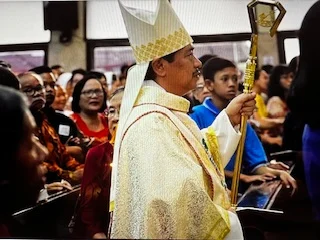
A Process for Selecting Our Bishops

The meeting opened and closed as always with a prayer. An introduction was given stating the purpose of this gathering: Having had two previous meeting on the challenges with the present system for bishops’ appointments and a second exploring alternative processes for selecting our bishops in a synodal process to involve all the People of God, this gathering was held in smaller groups to discern the details of how a process involving the clergy and laity could come together in local church communities.
Now that the 2024 Final Document of the Synod has endorsed having clergy and laity involved in the selection of bishops, a worldwide meeting was held Saturday, December 14, 2024 to explore possible approaches for how this process might take place. Fr. Steve Newton with the Association of U.S. Catholic Priests recommended that this take place when a vacancy is opening or when a bishop is reaching retirement age. With so many aging bishops throughout the world, there is vast opportunity coming up to implement this process. To be prepared, a plan needs to be established by each local diocese. Representatives from North America, Europe, and Australia were present for the meeting consisting of priests actively serving in parishes, married priests, lay women and lay men.
Breakout Room Conversations
The following questions were raised and discerned by each participant:
What has been your experience of the appointment of your bishops in the past (whereby candidates were recommended by the Apostolic Nuncio to the Dicastery for Bishops in Rome with the Pope making the final appointment)?
In general, all agreed that there has been little in the way of synodality in the present canonical process of selection of bishops in their areas.
- Bishops were just appointed or imposed upon us.
- Some have been invited to attend the ordinations of bishops.
- One person accounted a 1968 experience in their diocese in which the presbytery gathered to express their selection of three suggested candidates to fill the vacant see. Despite the opinion from the Vicar General that, with the death of the ordinary, the presbytery does not exist, the group came up with the names of three candidates which they submitted to the Metropolitan archbishop. It’s not known if that had any impact on the selection. But the second candidate suggested was the one who succeed as bishop-designate. In this early post-Vatican II era, however, the involvement of laypeople did not occur.
What qualities do you seek in the person chosen to be your bishop?
Candidates should:
- “Smell like the sheep”
- Imitate the approach of Christ
- Be followed not because they “have to” but because they “want to”
- Sense a responsibility to those served
- Be a listener more than merely an administrator
- Reflect the mind of those they lead
- Have vision
- Be a servant leader with compassion rather than a “Careerist’
- Be a servant leader who listens and is inclusive
- Have a track record of social justice encouraging others
- Hold pastoral care as primary, going out to the marginalized
- put into practice that which has been advised in the synodal report
- Be a multi-issue person, as opposed to a single-issue person
- Tell the truth with no history of sexual abuse coverups
- Be readily accessible to all
- Be a people person, engaging yet having the substance to lead
- Emphasize feminine characteristics, a model of caring for all, utilizing he/she pronouns
- Embrace and celebrate all cultures within the diocese
- Be less of a “Vatican Mind” or “According to the Canon Law Description” than “Modeled after the Christian Scriptures”
With the following as a guide, what are your insights for ways to proceed with selecting your next bishop in your parish or community?
- Nomination process: General agreement was selecting bishops should be modeled on the synodal process. The bishops’ selection process should start at the level of parishioners in collaboration with the clergy and nuns discernng the desired qualities of a bishop. There was general agreement that the clergy and nuns, who best know the priests, should offer a list of names of possible candidates as nominees for the position of bishop. It was suggested that this list might go the diocesan pastoral council for further discernment after which they could offer a short list of candidates.
- Having a period of public discernment: The faith communities should hear from and be able to interview the various candidates as a further means of discernment; there was general support for the need for this period which could take up to 2 months or more to allow the candidates time to share their insights into what each one perceives is most needed for the diocese and to give the People of God an opportunity to ask questions.
- Hold Conversations in the Spirit : General agreement that many small groups should be held to prayerfully discern who among the candidates possesses the qualities most needed for their diocese; enough small groups and adequate time given to allow everyone the opportunity to participate.
- How to set up the selection process to fairly represent the entire diocese in choosing a bishop who will best serve the needs of the community: Some felt that the connotation of “election” smacked of a political process and should be replaced by “selection” or “choice”, like Acts 1:21-26 and Prv 16:33. The method for how votes will be cast for the election/choice process should be inclusive of all in the diocese following the synodal process. This presumes a preparation and education process at all levels in the diocese from “grassroots” to the “administration.” An example suggested by one was the image from the film Conclave. The Cardinals all seemed so human when they were in their non-clerical clothes. But when they were fully vested they appeared almost ridiculous.It was also suggested that all parishes/faith communities throughout the diocese should reach an agreement for the most suitable process for their diocese to choose the right person among the candidates.
- An ordination of the person chosen: Ordination of the bishop should be a major celebration held in the diocese with all invited including other faith communities in an ecumenical fasion; it should involve the whole community to the extent possible.
As you listened, what suggestions resonated most for you? Name any recommendations or specific actions that emerged for any of the above.
All Catholics should be educated, encouraged and supported in the synodal process of selection of bishops. Every catholic needs to have the courage to speak up and start to take action to move toward a fully synodal church. Parishioners are in need of adult education and formation in regards to Conversations in the Spirit, informed discernment and taking action within a synodal church, being co-responsible in the functions of the church including the selection and appointment of bishops; this education/formation will take time and develop in stages.
The Diocesan Pastoral Council needs to fully reflect the whole community—from the grassroots, The synodal process needs to be implemented through the whole diocesan “mechanism.” The German episcopacy model was suggested as a blueprint to be imitated. The USCCB is not equipped for this since many dioceses have “rubber-stamp councils. There needs to be less “follow the bishop” mentality and more “follow the people of God in communication with the Spirit.”
Many suggested candidates who are apt for the role don’t want it; others who aren’t apt want the role. Many with “Vatican II spirit” are retiring; younger candidates seem to be “throw-backs to pre-Vatican II”. Candidates should want to represent the people through Conversations in the Spirit. This is a long term process to overcome “the generational divide.” This will take time. But it is crucial to start now!
Thinking into the future demands recognizing the equality of women and acknowledging that women make it work and take action on that. As we discussed, it was clear that, as valuable as our international representation was, represenation was lacking from Asia and Africa. Thinking outside the existing system is needed to inspire a sense of co-responsibility of the laity in partnership with the clergy: “Be the Church You Want!”
Action Items recommended
a) Ensure the synodal process reaches the grassroots level and empowers the laity to be involved in the selection of bishops. [This is very difficult in many dioceses because the bishop does not buy into the synodal process; also, the current formation process is providing young candidates trained in old school ways which means a synodal process would not have an adequate pool of candidates to select from.]
b) Establish diocesan-wide discussions on the desired qualities of a bishop, including ecumenical input.
c) Promote the formation and involvement of small Christian communities as a way to engage the laity.
d) Encourage bishops to actively promote and support Small Christian Communities within their dioceses.
e) Explore ways to introduce changes, such as the ordination of women, even if the church is not fully “ready,” as a means of expediting the necessary transformation.
f) Consider what a “good bishop” would do to empower the people to listen to the Spirit, in preference to the less discerning path of simply listening to the bishop; Engage with the bishop toward that end, on an ongoing basis not just at the time of selection.
Comments on our American bishops’ approach
The formation and selection of Catholic bishops is vital work and this process requires change.
On accessibility, in most of the Catholic dioceses in the world, traditional bishops are inaccessible to the Catholics whom they “serve.” It appears that their offices are protected by bureaucracy, akin to corporate CEOs. The Catholic Church is a powerful global corporation. The Church’s wealth is largely hidden, with no official public disclosure of its investments and full financial status, making accurate estimates challenging. It is estimated to be in hundreds of billions of dollars.
Corporatism is growing with the primary goal of monetary accumulation and socio-political leverage for sustaining greater and greater power. Corporatism allows no room for other organizational goals, such as following the true teachings of Jesus.
Pope Francis’ call for Climate Action is another issue where silence is apparent among our bishops. Many of our bishops and Catholic Institutions are defiant to his call and continue to maintain huge investments in fossil fuel industries.
The media has covered recent false accusations, made-up rumors and violence against immigrants, minorities and other marginalized people. Through their silence in neglecting to condemn this maltreatment, those U.S. Catholic bishops are complicit in this violence. It appears that our bishops have chosen to support White Christian Nationalists.
Another example of this apparent support concerns the celebration of certain feast days. After decades of celebrating the Feast Day of Mary in the local cultural vernacular, one diocese deleted any notice of this feast day Eucharistic celebration, and the bishop ordered that this cultural vernacular language was not to be used. And many bishops have now approved Latin usage again.
Many bishops have limited their speech and written letters to their diocesan members to one single issue, that of abortion. They are negligent in the other areas of social justice, particularly the scandal of coverups on sexual abuse. They are losing many caring Catholics among their parishes due to this scandal. They are having to provide payouts to the sexual abuse victims and consequently are declaring diocesan bankruptcies. What seems to follow this is a “restructuring” of these diocese.
We need the laity to step forward with courage to cultivate and further the necessary changes in the bishop selection process.
We then returned to the main room . . .
Fr. Max Stetter with the Association of German Catholic Priests raised the point that Pope Francis chose the word “process” for this synod. Several mentioned what a beautiful experience this Conversation in the Spirit has been but this is just a step in the process. The real work is to implement this process in local dioceses throughout the world. It’s up to each parish community to not wait for instructions from the Bishops’ Conference or other hierarchy but to actually begin this process. And the first step is laying out a plan.
Rene Reid commented on some suggestions shared that opened her thinking: Maree Sobolesksi from Australia suggested that before the process even begins, there should be a diocesan wide discussion on the qualities we all seek in a bishop. Margaret Mary Moore from the U.S. said that a bishop must have a track record of social justice and a history in stirring up the community to get involved. And Malcolm Nazateth from the U.S. said the ordination process should be ecumenicdal and include other faith communities from the diocese.
Fr. Max added that synodality is not in the grassroots yet. And until this happens, our involvement in the selection process will not work. How can we ensure that the People of God inspired by the Holy Spirit will take interest and become involved in choosing their bishop?
Mary Louise Knapp from the U.S. highlighted Margaret Mary Moore’s stressing the importance of education for the clergy and laity. That must come first.
Fr. Max said that there are thousands upon thousands of Small Christian Communities in Africa. He was there fifty years ago when they first began due to a shortage of priests. He beleives these are the Church of the future. Many present acknowledged they were currently part of an SCC.
Mary Louise Knapp from the U.S. highlighted Margaret Mary Moore’s stressing the importance of education for the clergy and laity. That must come first.
Fr. Max said that there are thousands upon thousands of Small Christian Communities in Africa. He was there fifty years ago when they first began due to a shortage of priests. He beleives these are the Church of the future. Many present acknowledged they were currently part of an SCC.
Margart Mary added that Charistmatic Renewal is just one program that fostered eduating people in having a personal relationship with Jesus. But they stopped there and never veered into guiding people into the importance of standing up for social justice and the like.
Peter Johnstone from Australia said that part of the formation process for bishops, clergy, and laity is letting everyone know that the laity is expected to be co-responsible members of the community. But he worries that too much time will be lost in this process and we won’t get on with implementing such things as the bishop selection process. The institutional Church is a master at using diversion tactics to delay the process. We will hear the Church isn’t ready for women priests; the Church isn’t ready for the people to have a say in choosing their bishops. Unless we in fact begin the process, we will not change as a Church!
Clylde Christofferson from the U.S. added that there are some rare parts of the world where this is already happening. It needs to be enouraged and gradually will spread by word of mouth.
Marie Sobolewski said she’s been involved in Catholic Charismatic Renewal for over forty years and feels that it had led to participation, mission, and community. There are the Nuncio’s role in this process and so many similar issues that could delay things, but unless we just began and take some action steps to begin the process, it will never happen.
Barry Ryan from the U.S. mentioned a book called The Wisdom of Tenderness written over 20 years ago by Brennan Manning. It said even back then that “Weekly small group meetings are not just for the devout. They are a universal necessity.” One hour out of 168 hours in a week is not enough to enhance our spirituality. Small Christian Communities are an answer. All agreed that promoting this process for selecting our bishops isn’t going to come from the hierarchy. It will only happen if we, each in our local community, make it happen. We invite those reading this report to take that first step. Determine the qualities your community seeks in a bishop and proceed from there.
Your donations are most appreciated
YOUR GIFT – IN ANY AMOUNT – IS PRICELESS
When you make a donation to support our cause, you join with others who are investing in restoring our Church to what Jesus intended. The dollars we receive are used to run our programs and to reach a broad spectrum of the People of God. We are focused on reaching out to the Faithful, reform activists, young adults as well as those who feel abandoned by the Church, to mention just a few. Your personal contributions in offering your suggestions and your donations are most appreciated.
We have begun to genuinely join our voices together behaving as a synodal Church. Let us now be willing to assume co-responsibility for our role in selecting our bishops. It will not happen unless we the laity together with our clergy initiate the process. We will keep you informed of more to come as we move forward to become a more synodal Church. We will continue to offer more online gatherings as a community.
On behalf of the CCRI steering committee,
Rene Reid, CCRI director