
Synodality and Gender Justice: Misogyny and the Denial of Women’s Humanity in Indonesia
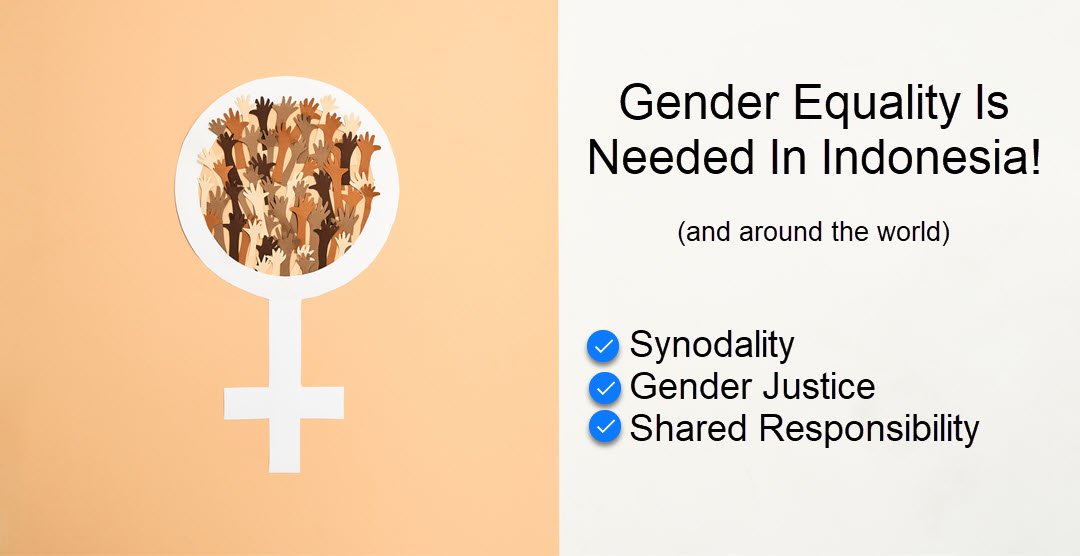
Misogyny, commonly understood as hatred, contempt, or systemic discrimination against women, remains a persistent and deeply embedded issue in many societies, including Indonesia. Despite significant progress in education, democratic development, and legal reform, gender inequality continues to manifest in both subtle and overt ways in everyday life. More often than not, misogyny does not appear through explicit hostility, but through normalized attitudes that deny women full autonomy, reduce them to objects of male desire, or position them as individuals whose choices must be controlled.
At its core, misogyny reflects a deeper failure to recognize women as fully autonomous human beings. Rather than being seen as individuals with independent rights, desires, and boundaries, women are frequently treated as extensions of male expectations. This mindset is evident in everyday interactions, from the way women are judged for their clothing and behaviour to how their personal decisions, particularly in romantic relationships, are scrutinized and regulated. When a woman refuses attention, rejects a proposal, or asserts her independence, she may face ridicule, social pressure, or even hostility.
In Indonesia, patriarchal norms continue to shape social expectations. Women are often expected to be polite, accommodating, emotionally supportive, and responsive to male attention. While these expectations are often framed as cultural values of harmony and respect, they become problematic when they implicitly discourage women from asserting clear boundaries. A woman who firmly rejects someone may be labelled arrogant or cold, while one who prioritizes her independence may be perceived as selfish. These attitudes subtly reinforce the notion that women exist, at least in part, to fulfil male emotional needs. The consequences of such beliefs become particularly visible in cases of gender-based violence. Violence against women rarely emerges in isolation; rather, it is rooted in a broader cultural environment where male entitlement and control are normalized. When men internalize the belief that they are entitled to women’s attention, affection, or obedience, rejection may be interpreted not as a legitimate boundary, but as humiliation or betrayal.
A case in Indonesia illustrates this dynamic with disturbing clarity. In February 2026, a violent attack occurred at UIN Sultan Syarif Kasim (UIN Suska) Riau, where a female student became the victim of a brutal assault by a fellow student after she rejected his romantic advances. The victim, a 23-year-old student identified as FAP, was waiting to attend her thesis proposal seminar when the attack occurred. The perpetrator, a 21-year-old male student identified as RM, had deliberately brought weapons from his home, indicating clear premeditation.

Figure 1. Location of the incident at UIN Suska Riau. Source: Instagram account @uinsuska, February 2026, accessed March 14, 2026.
According to investigations, the perpetrator targeted the victim specifically because he could not accept her rejection. Their prior acquaintance, formed during a university program, escalated into violence when his expectations were not fulfilled.
This case demonstrates that such violence is not merely emotional impulsivity, but a deliberate act rooted in entitlement and control.

Figure 2. Location of the police office after the perpetrator was arrested. Source: Instagram account @uinsuska, February 2026, accessed March 14, 2026.
The victim suffered severe injuries and required extensive medical treatment. The case sparked public debate, particularly after the National Commission on Violence Against Women emphasized that the incident should not be framed as a “romantic tragedy,” but as gender-based violence grounded in unequal power relations.
Public reactions to the case further revealed problematic patterns. Rather than focusing solely on the perpetrator’s actions, some narratives questioned the victim’s behaviour, reflecting a tendency toward victim-blaming. Such responses illustrate a broader societal difficulty in fully acknowledging women’s autonomy.
Violence is never a justified response to rejection, yet discourse often shifts attention away from accountability.

Beyond physical violence, misogyny is also evident in digital spaces. Women frequently experience online harassment, cyberbullying, and non-consensual use of their images. Emerging technologies, including artificial intelligence, have introduced new forms of exploitation such as deepfake pornography, demonstrating that misogyny adapts to technological developments. Educational institutions are not immune to these dynamics. The case at UIN Suska Riau highlights that universities must actively cultivate cultures of respect, consent, and equality. Without deliberate intervention, academic environments risk reproducing societal biases rather than challenging them. Efforts to address misogyny must therefore go beyond legal accountability. Cultural transformation requires education, critical media engagement, and the promotion of emotional intelligence and respect for boundaries. However, these efforts remain incomplete without a deeper rethinking of how society understands participation, authority, and shared responsibility.
Synodality, Gender Justice, and Shared Responsibility
In this context, the concept of synodality offers a meaningful framework for addressing gender injustice. Synodality, understood as a process of walking together through listening, dialogue, and shared discernment, emphasizes that every individual has a voice and that decisions should emerge from inclusive participation rather than hierarchical domination. Through this approach, equality and dignity are not merely theoretical principles but lived realities shaped by mutual recognition.
A synodal perspective creates space for women’s voices to be genuinely heard, particularly in contexts where they have historically been marginalized. Listening becomes an act of acknowledging humanity, while participation becomes a pathway toward empowerment. In this sense, synodality directly contributes to promoting equality and dignity by ensuring that no voice is excluded from the process of dialogue and decision-making. Furthermore, synodality redefines leadership by promoting co-responsibility between women and men. Leadership is no longer understood as authority exercised by one group over another, but as a shared responsibility grounded in collaboration, mutual respect, and accountability. Co-responsible leadership requires both women and men to actively participate in shaping social and institutional structures, challenging traditional hierarchies that privilege one voice over others.
Importantly, the conversation on synodality and gender justice must extend beyond a single national context. The challenges faced in Indonesia reflect broader global patterns of inequality. Therefore, meaningful progress requires dialogue across different countries and cultural settings. Presentations and contributions from diverse contexts can enrich understanding and reveal both shared struggles and unique perspectives. To support this process, it is essential to form collaborative teams that bring together insights from various countries. Such teams can synthesize different experiences, develop comparative perspectives, and produce collective drafts that reflect a truly global conversation. Through this collaborative effort, the pursuit of gender justice becomes not only a national concern but a shared international responsibility.
Ultimately, addressing misogyny is not only about preventing violence, but about recognizing women as complete human beings with equal dignity, autonomy, and moral agency. A society that fails to respect women’s autonomy undermines its own ethical foundation. The tragedy at UIN Suska Riau serves as a reminder that rejection is a normal part of human relationships, but violence is always a choice. If Indonesia is to move toward a more just and humane society, it must confront misogyny not only in extreme acts of violence but also in everyday attitudes that deny women’s humanity.
Contact Information
Email: kristianaaurelalua@gmail.com
Phone Number: +628-219-961-2426 (Indonesia)
Instagram: @kristiana.aurel
Member Online Young Adults Seekers Small Christian Communities
Alloys M Nyakundi (MPS)
Emmah’s Garden (https://emmahsgarden.org)
Catholic Church Reform International (CCRI)
Facilitator Online Young Adults Seekers Small Christian Communities
+254742309289 (Kenya)
Email: alloysnyakundi8@gmail